RENEE ESTEBAN

You Shoulds: Italy
You should visit Italy. The northern part, but not just Venice. The winding, water-logged city might as well be a different planet from the landscapes around it.
You should travel to the Dolomite Mountains and back. Trace a path like you’re smoothing kisses across a lover’s shoulders – reverent of every freckle, stretch mark, and millimeter.
You should start paying attention as soon as you reach the country. Choose a window seat on the bus, and don’t look away. It’s so hard to resist closing your eyes once you leave the airport. Your phone may adjust seamlessly to time difference, but you can’t. The travel smothers you in its exhausting smog, lost or gained hours weighing on you like your overstuffed suitcase. Nevertheless, keep your eyes open. Although – or maybe because – much of the scenery lacks the glossy, airbrushed charm of postcards, it is striking.
You should keep track of the clock towers as you pass them by. Tattoo the count on your thigh with anxious fingers. It is long before the mountains will appear to melt out of thin air, so the manmade peaks seem to be the only distinguishable features. They erupt from the earth as if from a children’s pop-up book. The houses clustered around seem insignificant for how quickly your eye skips over them. Still, their red roofs, tiled like fish scales, offer a pleasant contrast to the grey of the highway. In the vineyards, mildly colored wooden stakes are placed at equal distances to guide the growth of grapes. There is no inherent magic in this, but when the driver speeds past, everything blurs into an ocean just for you, the rows rippling like waves, turning greenish with the grass.
You should marvel at the palette of the passing land. Remind yourself that a place doesn't have to be surreal to be worth seeing. The fact that the grass and the trees are so green is enough. There's something in seeing flags ripple languidly as they hang from gas station roofs, sharp stripes for Italy and lions for Venice. Here, it’s not unusual to see a building painted completely red, like a Tetris block fell from the sky. In the residential areas, long buildings of apartments are painted in different pastels and brights like rows of gelato bins. Even shirts hanging off of clothing lines can make you stare as long as possible before the bus goes whizzing by, veering around a toy-like three-wheeled truck whose only cargo is bundles of scarlet and fuchsia flowers.
You should study the mountains, when they finally emerge from the relative flatness. Take note of the houses nestled up there. They look fitting and so out of place at once, like mountain perched on an almost-vertical cliff, the precise angles of architecture forced to coexist with the adamant imperfection of the ridges. The mountains themselves appear alive, looming in and out of view, periodically blocked out by the blindness inside concrete tunnels. The emergence of the mountains at the other end, though not a surprise, is disorienting, forcing you to reacclimate yourself often in a way that seems unnatural for masses so unyielding.
You should be aware of our place in nature. Out the window, you’ll find piles of neatly stacked timber on the side of the roads, leaving hundreds of naked spaces among those left behind. The green of their fallen needles matches the shade of the mountains, which is mimicked by the telephone towers you’ll come to notice placed among the trees. Once you start, you can’t stop seeing them, obvious like cheap knockoffs despite efforts to be inconspicuous. They are erected in valleys and on mountaintops, placed like flags on the moon, confirmation of conquered ground. Yet further down the winding roads, a bridge is being swallowed by vines and a house is losing ground to an overgrown tree – nature is slowly regaining territory.
You should stop in the town of Pieve di Cadore as you begin your ascent. There is a statue of a famous painter in the square, ignored by kids who are kicking a ball around without a care for whether or not it hits you. A fancily framed print of Gustav Klimt’s The Kiss hangs inside a lovely hotel. A hiking trail leads to Forte Monte Ricco, a World War I bunker that has been repurposed into a contemporary art exhibit. A red mailbox stands outside a cabin, patiently waiting for children's letters to Santa. In the middle of the night, a middle-aged man spins bad ’90s music in an empty pub, one of two in the town. He does so with an air of such gravity, standing alone among the pulsing lights, that when he looks up and smiles, childlike, it’s almost frightening.
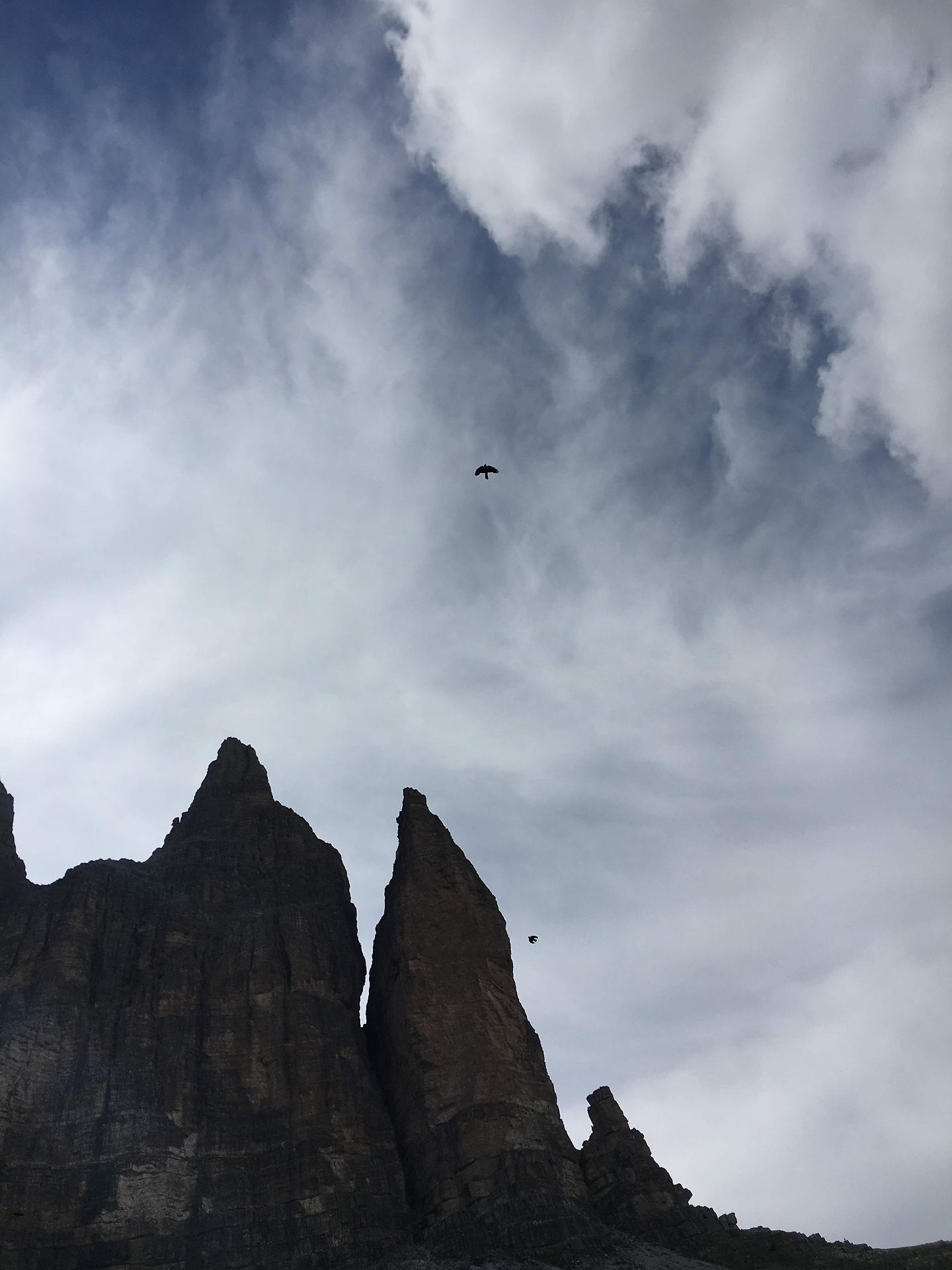
You should consider contrasts. The Dolomites, a mountain range forming a section of the Alps, are covered with trees at some points, and perfectly bald like summer-shorn sheep at others. Tourists inject their destinations with energetic voices, but somehow suck the life out of the previously silent spaces. Ice forms at the tallest peaks, and far far below you sweat in the burning sun. A WWI memorial, an imposing stone angel with rust climbing across his stoic face, is turned towards the valley on the edge of a cliff, hidden from sight. Birds glide effortlessly in the wind that threatens to push you off the rocky trails. Fascination with the remnants of a military bunker, pictures snapped of platoon numbers stamped into the rocks, are only possible because of so many needless deaths. Texts sent using the wifi at the Rifugio Lavaredo are a privilege that those soldiers couldn’t have imagined but surely would’ve treasured, seeking comfort in the face of their almost-inevitable ends.
You should acknowledge time. There is a thoughtless fog that sometimes seeps into our minds and makes us forget that a place existed before we ourselves arrived. It's easier to notice history in spaces made by man, with our designs that become outdated as quickly as we can build. We are not made to last. Proof is driving on narrow roads, seemingly seconds away from colliding with another car or tipping over a ravine. It's passing by a cheery little house selling grave stones, inescapable. A faded sign sits at the very edge of a cliff. You lean precariously close and squint; it is warning you of imminent danger. Everything ages, even nature. The ridges of the Dolomites were shaped over two hundred million years of water flow. The tunnel entrances dug into their faces, like holes in an ant hill, were shaped over two years during World War I when the Austrians and Italians were fighting to take control of the mountains and exterminate each other. The cliffs are patterned like geode. In our camouflage, we imitate nature, and nature imitates itself.
You should test the familiar. Listen to your favorite song when you're hiking along. Start playing it very softly, like an afterthought. Listen to the way you can hear the call of the blackbirds mix with something you love. Think about where you are when you usually listen to this song – your room, your car, the train – and who you’re with. And now? Are you alone, or more importantly, do you feel alone? Can you close your eyes and pretend that you’re somewhere you know like the back of your hand, or is your position on the uneven gravel path too unfamiliar? Will you remember this moment the next time you listen to the song, or will you try to forget? Turn the volume up once for every time you find yourself unable to process the sights in front of you, or every time you slide on the small, jagged rocks covering the sloping trails. Kick one off the side of a ravine. Watch it skitter down, picking up speed with each other rock it jolts against. Realize, with a turn of your stomach, that you are soft and breakable, and watch your step.